


PULSE MARKET UPDATE – March 2026
Commentary
Market values have been remarkably static since the autumn of 2025 with little to report and a clear explanation is not so easy to find. The DEFRA declared cropped area for pulses in 2025 was below 200,000ha – the lowest since crop 2019 and a drop of over 73,000ha over two years – most of which appears to have been at the expense of field beans. It is highly likely that this reflects the negative impact of the uptake of SFI options, although recent inconsistent crop experiences may not have helped. With reduced crop area and a relatively disappointing harvest, traders have generally revised down their estimation of the national bean crop production to around 400,000 tonnes. While pea yields were also impacted in 2025, pea markets are mainly being influenced by the availability of cheap imports.
The European pulse market is currently showing little interest in UK product, faced with cheap alternative protein sources and lower pulse crop prices of European and Canadian origin. The markets have been distorted by Chinese tariffs on Canadian trade, which although now eased, has forced large volumes of Canadian peas into other markets at low prices.
The 2025 Australian bean crop appears to have topped 1,000,000 tonnes and this origin is dominating the traditional Egyptian and North African human consumption markets. With over 210,000 tonnes delivered or on the water so far, the market is currently full.
As the winter splutters to a close the spring sowings are eagerly anticipated with many expecting a crop area broadly similar to 2025. Some hold a more optimistic view with availability of revised SFI options being less clear, the certain benefits of pulses in their rotation may prove more attractive. The deeper view in the market appears to be that while fortunes of the pulse crops vary annually, their longer-term prospects are rosier, and with a significant role to play in food security, domestic protein production and environmental concerns, they have an increasingly significant part to play in UK agriculture in the years ahead.
Interest in peas has already been strong with the availability of most contract offers already exhausted.
The winter bean area appears to have increased. In the last bulletin we commented on those considering early drilling opportunities for winter beans, with the recommended time being from mid-October. After a couple of years without penalty for early drilling, 2025/6 will be a reminder of the risks. Chocolate Spot has rarely been seen in such an advanced stage in so many crops as it has been this season, with our earliest ever recommendations for its control issued in our mid-February Crop Update. https://www.pgro.org/pgro-crop-update-number-3-23rd-june-20251/
UK PULSES
Feed Beans
The market has been quiet for some considerable time. Current offers for beans are around £205-£210/t ex farm depending upon location. While these levels are lower than a year ago, values have not seen the movement or volatility that has been experienced in the wheat market. Offers for 2026 crop based upon buybacks of around £30/t over wheat futures are being met with positive interest but modest early commitment.
The market is being sustained by those committed to bean inclusion. Purely on a price per unit of protein basis UK beans are not appealing to flexible feed compounders seeking regular reliable supply. Price remains key to animal feed inclusion and, unusually, beans have maintained a roughly £45-£50/t premium over wheat for many months. When compared to soya as the main alternative protein source, beans are about £25/t too expensive for least-cost formulations and while beans are not judged on protein value alone, this is still too much to carry for most feed buyers.
That said, it is understood that there are beans available on farm and traders seeking suppliers are still finding sellers reluctant, so with no immediate demand to force trades, the prices remain more or less static. The general view is that despite a smaller crop area in 2025 and lower than average yield, a small exportable surplus of beans may carry over to meet crop 2026 at harvest.
Export beans
The demand for exports this year has been almost non-existent. The EU feed market is influenced in a similar way to the domestic feed industry and is utilising beans and protein sources from alternative origins, both within Europe and further afield.
The traditional markets for human consumption have all but dried up too, with Australian origin beans dominating that supply for the rest of the season. Australian beans are generally larger in size and carry fewer blemishes, making them visually more appetising. Added to this, they are currently around US$150/t less expensive in the Egyptian market than similar quality beans of European origin. With the price for feed markets remaining high and traders unable to put together consignments of sufficient volume, there is currently no premium for this market.
UK combining peas
As mentioned above the pea markets have been caught in the backdraught of events leading to the availability of cheap imports both into the UK market and the traditional export markets in Asia.
The value of a production contract to the farmer has probably rarely been more apparent than in this situation, with traders committed to taking UK contracts at values significantly higher than the prices available in the end use markets. This has made export trading extremely difficult, with significantly reduced volumes being moved largely for the maintenance of long-term trusted trading relationships.
This is not a new phenomenon but has not been seen in this extreme for many years. Seeking to try and iron out the boom and bust supply cycles, the UK industry has worked hard on supporting growers through contract production, matched to anticipated demand. Evolving political events have upset the balance and the UK market looks set to have a surplus of peas from crop 2025.
With traders focused on their contract commitments, if a buyer can be found, peas grown for the open market from crop 2025 may have little value over feed. There is a strong chance that this will persist into 2027.
The market for beans and the upside demand, is significantly larger than for feed peas and it may be prudent for those without a 2026 pea production contract but seeking the benefits of a pulse crop, to consider drilling beans instead.
Unless specified as related to contracts, price indications below refer to produce offered in the free or open market.
Green peas
Contracts (with quality clauses) for crop 2026 were quickly snapped up at around £360/t and are now exhausted.
When micronisers are in the market for top-quality produce the prices trend higher, but even these have fallen to around £275/t ex farm in recent months. Falling from a high of well over £300/t.
Heavily bleached samples off contract are likely to trade at around feed bean prices.
Marrowfat peas
Contracts for 2026 are likely to be fully subscribed. Mostly closed (with quality clauses) at £400 – £450/t ex farm.
Current values for off-contract samples entirely depend upon quality and a willing buyer.
Yellow peas
Current international surpluses mean the market is oversupplied. It is understood there are no remaining UK contracts for crop 2026.
Currently imports can be bought to arrive at UK ports below the cost of UK production.
Maple peas
A few contracts remain available for crop 2026. Contact your merchant if interested. Current values ex farm roughly £420/t.
Supply and demand in Maple peas does not seem to easily find a balance as the market size is small, and most contracting merchants hold back to their core demand. As noted in earlier reports, a slightly lower yield potential over green and yellow peas should be expected with a further reduction for late drilling.
NOTE:
“This report is independently compiled by the PGRO using a variety of information sources and summarised commentary from within the UK pulse trade. It is intended as a guide only without any guarantees. It is accurate to the best PGRO’s knowledge at the time of compilation, but no assurance is given, nor any acceptance of responsibility for actions taken as a result of its use.”
Agronomy notes:
Winter bean disease
Chocolate spot in winter beans has developed rapidly in the conditions experienced in January and February. Foliage has remained wet with no extended drying periods and has had good conditions for development.
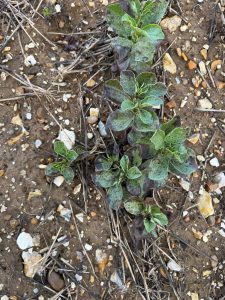
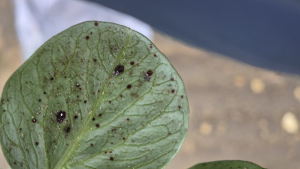
Early applications of fungicides may be necessary to prevent further
disease development, and none of the approved products are curative. It is important to prevent infectiondeveloping in crops while weather remains unsettled.
Guidance here:
https://www.pgro.org/pests-and-diseases1/
Spring drilling
Do not be too concerned with the calendar date and if the soil appearance suggests the likelihood of good seed soil coverage, take the opportunity to drill both peas and beans. While still chilly, soil temperatures are starting to rise and so long as there are no fundamental soil structural issues conditions are likely to change quickly at this time of year. Earlier drilled crops placed into good soil conditions, tend to perform better.
For more on early crop husbandry;
Peas: https://www.pgro.org/crop-husbandry/
Beans: https://www.pgro.org/crop-husbandry1/
PEA BRUCHID
Growers and traders alike are urged to look out for Pea Bruchid damage in peas in the 2026 crop. Pea Bruchid has not previously been found in UK produced crop. In 2025 it was detected post-harvest in crops near Cambridge and Newark. The potential for this pest to do severe damage to the UK pea industry is serious. The incident is reported on the PGRO website here: and there is more. information on identification and management: https://graphicgeneweb.co.uk/Spring-pulse-2026/ page 18
PGRO working with the AIC, BSPB and other trade organisations to try and ensure this pest does not become established in the UK. Growers and agronomists are urged to carefully inspect crops from the beginning of podset onwards and report any suspicious insects, eggs on pods or damage using the PGRO Crop Monitor App.